Every week I get a version of the same message: "Bhavna, we have a 2BHK in Powai — roughly how much will the interior cost?" And every week, I resist the urge to throw out a single number, because that number will be wrong for almost everyone asking.
2BHK interior projects in Mumbai range from ₹8L to ₹60L+. That gap is not a pricing mystery — it reflects fundamentally different scopes, material grades, and levels of finish. What this guide does is pull apart each layer so you can figure out where your project will land, and why.
One thing most homeowners don't realise: a 2BHK is not simply a cheaper version of a 3BHK. You still need a modular kitchen, two full wardrobes, a living room with TV unit and false ceiling, two bathrooms fitted out, and a foyer. The rooms are fewer but the fixed cost items — kitchen and wardrobes especially — are nearly the same. That's why 2BHK costs on a per-square-foot basis often end up higher than 3BHK projects of similar quality.
What Does a Typical 2BHK Interior Include?
Before we talk numbers, let's be precise about scope. A complete 2BHK interior in Mumbai covers:
- Living room: TV unit, false ceiling with recessed lighting, feature wall or wallpaper, sofa and centre table (if furniture is in scope), flooring if being replaced
- Kitchen: Modular base and wall units, countertop, backsplash, under-cabinet lighting, hob, chimney, sink — full modular kitchen is the standard expectation
- Master bedroom: Full-height wardrobe (typically 6–8 ft wide), bed with storage, side tables, study unit or dresser if required
- Second bedroom: Wardrobe, bed frame or divan, study table for children's rooms or a guest room setup
- Bathrooms (2): Sanitary fittings, tiles (if being redone), mirrors, storage vanity, shower partition or bathtub depending on master bath scope
- Foyer / entrance: Shoe rack, console or crockery unit, entry flooring treatment
- Electrical: Light points, fan points, switches and switchboards — all as per design layout
- False ceiling: Typically living room and master bedroom; sometimes kitchen and passage
- Paint: Walls and ceiling, two coats of emulsion minimum
If your quote covers only carpentry and leaves out civil, electrical, false ceiling, plumbing, and paint as separate estimates — you're not getting a turnkey price. You're getting a partial picture that will feel very different from your final bill.
2BHK Interior Cost Ranges in Mumbai 2025
These are all-in project budgets — not just carpentry. They include civil, electrical, false ceiling, paint, carpentry, hardware, and design supervision. Appliances and loose furniture are generally separate unless stated.
| Tier | Budget Range | What You Get | Who It's For |
|---|---|---|---|
| Budget | ₹8–15L | Carpenter-made joinery, basic laminate finish, local fittings, standard paint, no false ceiling, functional over aesthetic | Rental investment properties, tight-budget first homes, partial redos |
| Mid-Range | ₹15–30L | Modular kitchen, laminate wardrobes, false ceiling in living room, branded hardware (Hettich/Hafele), better lighting plan | Owner-occupied homes, 600–850 sq ft flats, most first-time homeowners |
| Premium | ₹30–50L | Full turnkey scope, custom-designed furniture, PU or lacquer finishes, feature walls, premium hardware, design-led lighting, textured paint or wallpaper | Larger 2BHKs (850–1100 sq ft), second homes, homeowners who want a considered aesthetic |
| Luxury | ₹50L+ | Bespoke joinery, Italian fittings (Blum, Grohe, Duravit), smart home integration, imported materials, custom millwork throughout, designer lighting | High-end 2BHKs in Bandra, Juhu, Worli — homeowners who treat the home as a long-term investment |
A quick note on what moves these numbers most: it's rarely the living room sofa. It's the kitchen, the wardrobes, the flooring, and the bathroom tiles. These four line items alone can account for 55–65% of a 2BHK interior budget. Getting the material grade right on these four is more important than any other decision you'll make.
What Affects Your 2BHK Interior Cost?
1. Flat Size — and Mumbai's Wide Range
A 2BHK in Mumbai can be anything from 550 sq ft (a compact Chembur flat) to 1,100 sq ft (a developer premium unit in Powai or Thane). The per-square-foot carpet area makes a significant difference. A 650 sq ft flat and a 950 sq ft flat both need the same number of rooms done — but the larger one needs more flooring, more paint, larger rooms to furnish, and more electrical points. Costs scale accordingly.
2. Material Grade
This is the single biggest lever. Switching from BWR-grade plywood to marine ply adds roughly ₹600–900 per sq ft of carpentry. Moving from a laminate finish to PU or lacquer adds another ₹700–1,200 per sq ft. Multiply that across a full 2BHK with 600+ sq ft of carpentry and you're looking at a ₹8–12L difference between tiers — just from material choices.
3. Scope — What You're Actually Getting Done
Are you doing a full home from scratch, or touching only the kitchen and master bedroom? Many homeowners in resale flats only need specific rooms redone. A partial redo costs proportionally less but has a higher per-room cost because mobilisation, design, and supervision costs don't scale down as sharply as material costs.
4. Number of Custom Elements
Standard modular furniture is faster and cheaper. Custom-built pieces — a curved TV wall, a window seat with integrated storage, a walk-in wardrobe with internal fittings — take more time to design, fabricate, and install. Each custom element adds cost. That's not a reason to avoid them; it's a reason to be deliberate about which ones matter to you.
5. Location Within Mumbai
Labour and transport logistics vary. Projects in South Mumbai or Bandra tend to cost slightly more due to access challenges, parking constraints, and higher local labour rates. Thane and Navi Mumbai are generally 8–12% more cost-efficient for similar scope, though material costs are the same.
6. Bathroom Scope
Bathroom renovations are often underestimated. If you're keeping existing tiles and only changing fittings, budget ₹80,000–₹1.5L per bathroom. If you're doing a full gut-and-redo — new waterproofing, new tiles throughout, new sanitary ware — budget ₹1.5–3.5L per bathroom at mid-range, and more at premium. Two bathrooms in a full redo add up fast.
Real Example — Indradhanush, Powai
One of the projects I'm most proud of is Indradhanush — a family home in Powai. It's technically a 3BHK at 976 sq ft, which puts it in the same size bracket as a large 2BHK. The total project cost was ₹45L, covering full turnkey scope: modular kitchen with quartz countertop, full-height wardrobes in all three bedrooms, living room with false ceiling and feature wall, two bathrooms fully redone with premium fittings, foyer unit, paint, electrical, and flooring throughout.
I mention this because it gives a real reference point. For a comparable 2BHK at 900 sq ft with similar material grade — marine ply, laminate-to-PU finishes, modular kitchen, two bedrooms, two bathrooms — a realistic budget would be ₹35–42L. That's the premium tier done properly, not extravagantly.
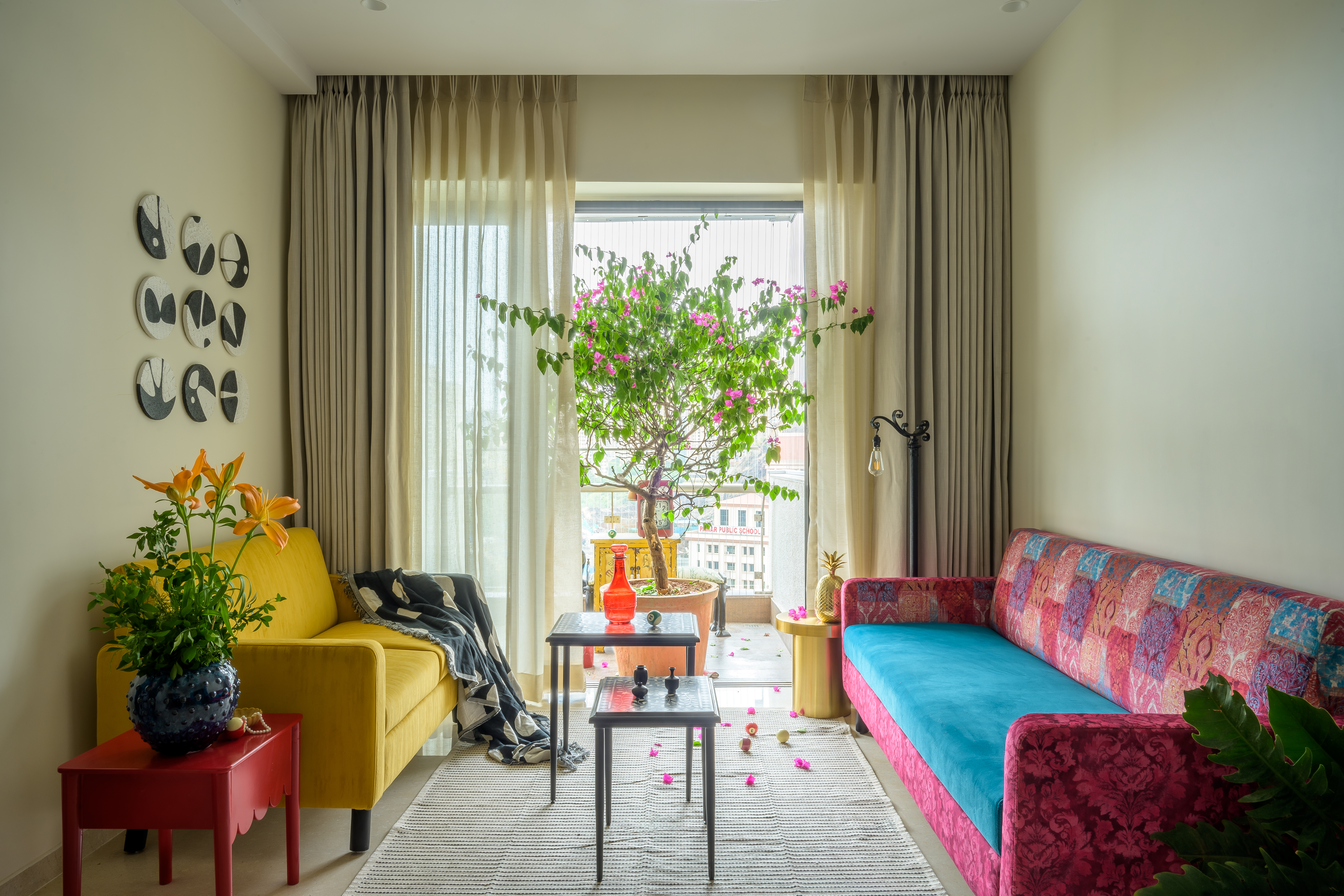
The living room from that project is the featured image on this page. It's a good example of what ₹30L+ gets you: a considered layout, materials that photograph well and live better, and a space that doesn't feel like it needs anything added to it.
You can see more of projects like this in our portfolio. For 3BHK-specific pricing, read our 3BHK interior cost Mumbai guide.
Common Mistakes That Inflate 2BHK Costs
Changing the Design Mid-Project
This is the single most reliable way to bust a budget. Once carpentry is fabricated and on-site, changing a wardrobe configuration or adding a unit to the kitchen means new material, new fabrication time, and rework on civil and electrical that was already done. Design changes after work has started routinely add 15–25% to the final bill. Fix your design on paper — completely — before anything is ordered.
Choosing Cheap Materials to "Save Money"
A BWR-ply kitchen done in 2025 will show delamination, swollen panels, and rusting hinges by 2030 in Mumbai's humidity. You'll spend ₹4–6L redoing it. The marine ply version costs ₹2–3L more upfront and lasts 15 years. The math is straightforward. Budget constraints are real — if money is genuinely tight, reduce scope (do fewer rooms) rather than reducing material quality on the rooms you do.
Splitting Vendors Across Work Categories
Many homeowners hire one carpenter, a separate electrician, a separate civil contractor, and source tiles themselves — believing this saves money. It usually doesn't. Coordination gaps between vendors cause delays, rework, and blame-shifting when something goes wrong. The carpenter didn't leave space for the electrician's conduit. The civil team broke a tile the homeowner sourced. No one takes ownership. The project drags from 60 days to 5 months, and the hidden cost of living in a construction site is very real.
Not Getting a Detailed BOQ Before Signing
A BOQ — Bill of Quantities — lists every line item: which room, which material, what grade, what quantity, what cost. If a designer gives you a lump-sum quote without a BOQ, you have no way to compare it against other quotes or verify what you're paying for. Always demand a BOQ. Any serious firm will provide one.
Planning your 2BHK interior in Mumbai?
Book a free consultation with Bhavna Gangani. We'll walk through your flat size, your scope, and your budget — and give you a realistic picture before you commit to anything.
Book a Free Consultation on WhatsApp →How to Get the Best Value for a 2BHK in Mumbai
Go Turnkey — One Contract, One Point of Contact
A turnkey firm takes responsibility for the full scope under one contract. If there's a problem between electrical and carpentry, it's their problem to resolve — not yours to manage. At Rebel Dezignz, I personally supervise every project I take on. That's not a marketing line — it's the actual working model. I am on site at key milestones, I approve material samples, and I am the one you call if something isn't right. There is no subcontractor maze.
Fix Scope Before Signing — Then Hold It
Spend 2–3 weeks in the design phase getting everything right on paper. 3D renders, material boards, electrical layouts, furniture plans. This investment of time at the start saves significant money and stress during execution. Once scope is agreed and signed, resist the urge to add "just one more thing." Those small additions accumulate.
Demand a Detailed BOQ and Compare Line by Line
When you get quotes from two or three firms, don't compare the totals. Compare line by line. Is one firm using marine ply and another using BWR? Is the hardware branded or generic? Is supervision included or billed separately? Is paint in the scope or separate? The cheapest quote is rarely the best value once you read the fine print.
Prioritise the Kitchen and Wardrobes
These two categories are used every single day. They take the most wear. They are also the hardest and most expensive to redo. If budget is tight, spend well here and cut back on the foyer console or the feature wall treatment — those are easier and cheaper to upgrade later. The kitchen and wardrobes are not.
Build in a 10–12% Contingency
Even with a detailed BOQ and a good firm, surprises happen during civil work — a hidden pipe in an unexpected location, a wall that needs replastering before tiling, a beam that changes a false ceiling design. A contingency buffer means these don't become crises. It's not pessimism; it's good planning.
Frequently Asked Questions
What is the average 2BHK interior cost in Mumbai in 2025?
For a full-scope turnkey project covering carpentry, false ceiling, paint, electrical, civil, and bathroom work — the average 2BHK interior cost in Mumbai in 2025 sits between ₹18L and ₹35L for mid-range to premium finish. Budget-tier projects start around ₹8–12L for smaller flats with basic materials. Luxury projects in larger flats or premium localities go above ₹50L. The final number depends on flat size (600–1100 sq ft range), material grade, scope of bathrooms, and how much custom carpentry is included.
Can I do a 2BHK interior for under ₹10 lakhs in Mumbai?
Yes, but with significant constraints. At ₹8–10L, you're looking at a smaller flat (under 650 sq ft), carpenter-made joinery rather than modular, basic laminate finishes, no false ceiling, and existing bathroom fittings retained. It's functional but not design-forward. This budget works for rental investment properties where durability and cost efficiency matter more than aesthetics. If you own and live in the home long-term, stretching to ₹15–18L makes a material difference in quality and longevity.
How long does a 2BHK interior project take in Mumbai?
A full 2BHK interior — from design sign-off to handover — typically takes 45 to 70 days at execution, plus 2–3 weeks for design finalization before work begins. Smaller scope projects (kitchen and two bedrooms, no civil) can finish in 35–45 days. Delays are most commonly caused by design changes after work starts, material sourcing delays, and coordination gaps when multiple vendors are involved separately. A well-run turnkey project with a fixed scope stays within this timeline reliably.